The myth of automatic personalization
Many tools talk about “intelligent personalization”. But what does it really mean?
True personalization comes from:
- direct observation
- listening to the family
- knowledge of triggers
- understanding the context
AI
can assist in writing.
It
cannot replace this phase.
A specific case
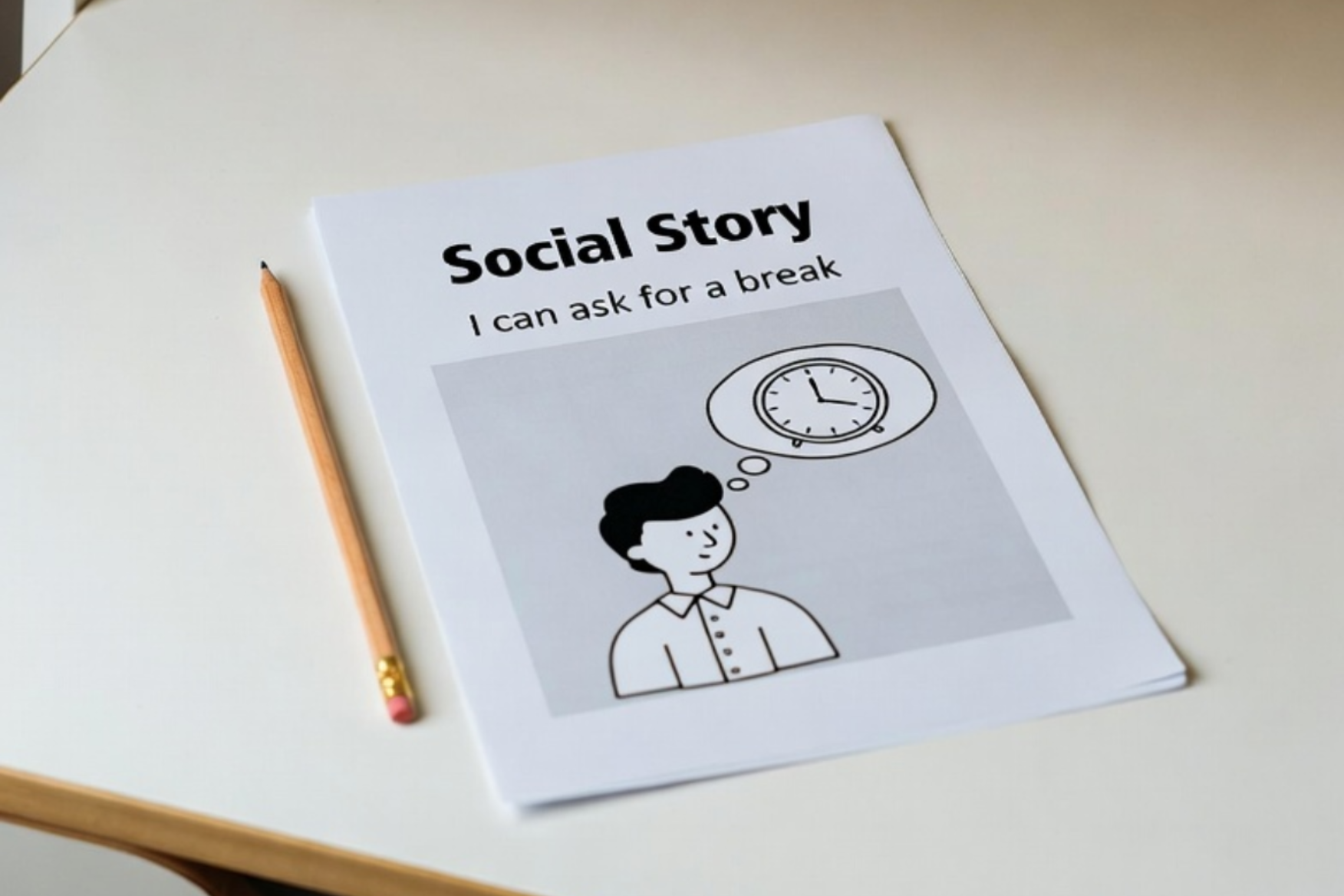
Davide, 11 years old, ADHD, has difficulty managing waiting during breaks.
A standard social story might say:
“During break time, many children want to play or talk at the same time. Sometimes I may need to wait.”
But for Davide, the problem is not just the waiting. It’s the uncertainty.
With AI, the educator can:
- generate variations of the story
- insert concrete examples
- adapt the language to his communication style
- create both short and long versions
But the final choice remains a professional one.
AI may suggest:
“I can wait calmly”
But a professional may recognize:
- the child struggles with uncertainty
- sensory overload during noisy breaks
- difficulty estimating time
This changes the entire intervention.
Real opportunities
AI can:
- produce alternative versions
- simplify vocabulary
- adapt for different ages
- assist in translation for foreign families
This expands accessibility.
Specific limits
AI does NOT:
- recognize unexpressed emotional nuances
- assess sensory regulation
- interpret complex behaviors
- replace clinical evaluation
Relying blindly risks creating superficial interventions.
AI processes patterns.
Human professionals interpret
meaning.
Change of perspective
Perhaps the real question is not: “Can AI personalize?”.
But: “Can it help me personalize better and faster?”.
The difference is substantial. Expertise remains human. Technology can amplify it.
Conclusion
Personalization is a process, not an algorithm.
AI can:
- accelerate the technical phase
- offer alternative formulations
- reduce cognitive load for professionals and families
But quality still comes from observation, relationship, and contextual understanding.
The most effective tools are not the ones that “replace” educators or therapists, but the ones that help them work with greater clarity, flexibility, and personalization.
This is also the direction behind platforms like
EduStories AI, which aim to support professionals and caregivers in creating more adaptable and individualized social narratives — while keeping human expertise at the center of the process.
If you want to explore personalized social stories and practical inclusive strategies further, you can explore more content from EduStories.
Personalization does not come from algorithms alone.
It comes from understanding the person behind the behaviour.
Current research in autism intervention, executive functioning, and educational technology increasingly suggests that structured personalization and anticipatory support can reduce cognitive load and improve participation in neurodivergent children and adolescents.
References
Carol Gray -
The New Social Story Book
Linsenmayer, E. (2025). Leveraging Artificial Intelligence to Support Students with Special Education Needs. OECD Artificial Intelligence Papers.
https://doi.org/10.1787/1e3dffa9-en
Pagliara, S. M., et al. (2024). The Integration of Artificial Intelligence in Inclusive Education: A Scoping Review. Information, 15(12), 774.
https://doi.org/10.3390/info15120774
UNESCO (2025). AI and Education: Protecting the Rights of Learners.
https://www.unesco.org/en/articles/ai-and-education-protecting-rights-learners
Holmes, W., Porayska-Pomsta, K., et al. (2024). The Ethics of AI in Education.
https://arxiv.org/abs/2406.11842
Sharples, M. (2023). Towards Social Generative AI for Education: Theory, Practices and Ethics.
https://arxiv.org/abs/2306.10063
OECD (2023). OECD Digital Education Outlook 2023.
https://doi.org/10.1787/c74f03de-en