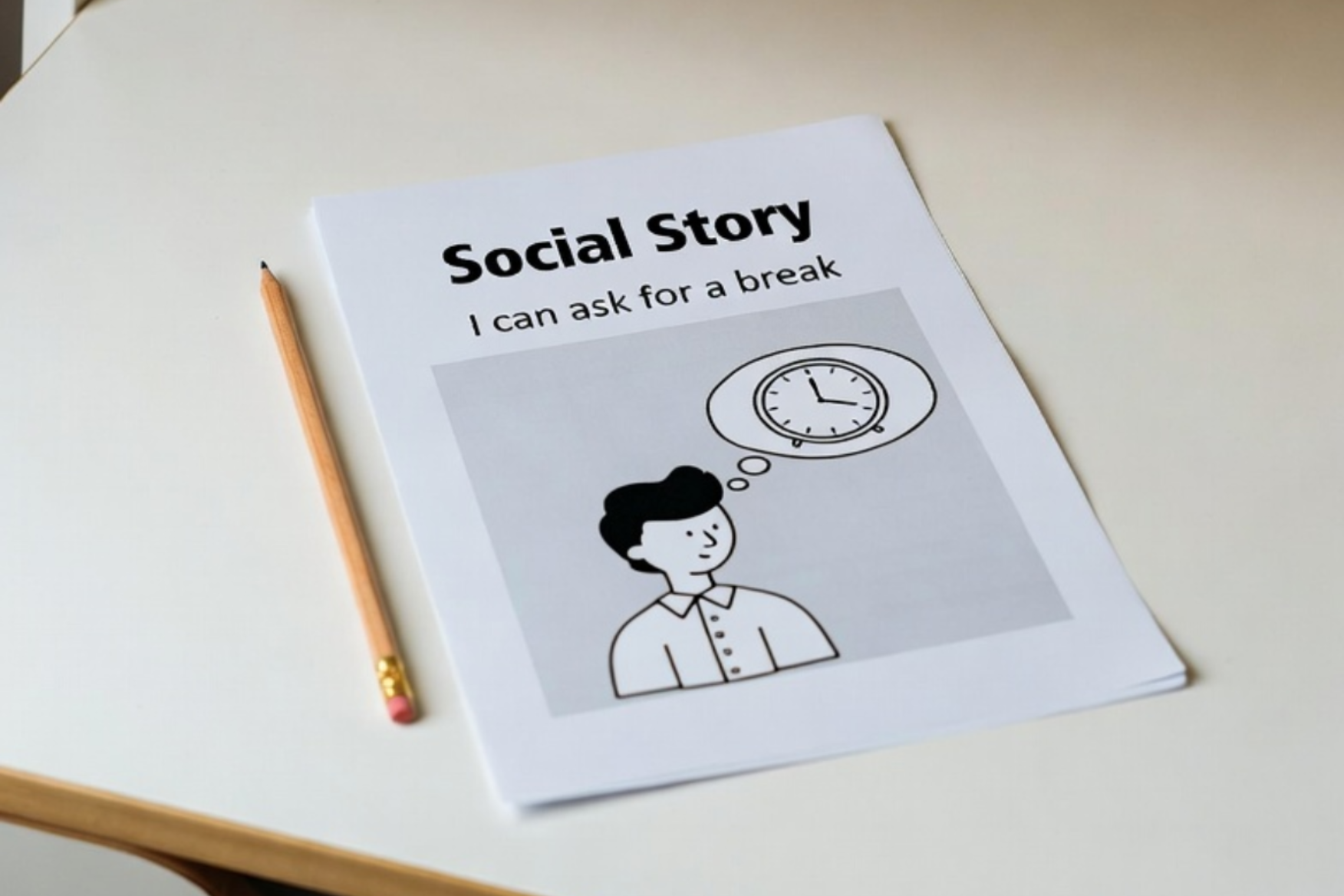

How to Write Effective Social Stories: A Practical Step-by-Step Guide for Parents, Educators, and Therapists
A practical guide to writing an effective social story: structure, language, common mistakes, and tips.
Writing a Social Story can feel surprisingly difficult.
Knowing what to say, how much detail to include, and how to make the story truly helpful often creates uncertainty for adults too.
This guide is designed for educators, caregivers, therapists, and parents who want to write Social Stories that are genuinely effective — without spending hours staring at a blank page. You’ll learn how to structure your story, choose the right language, avoid common mistakes, and see a real example that makes unpredictable situations more predictable for the reader.
1. Start With a Specific Situation
Instead of writing a general story about broad behaviours, focus on a specific event or context. For example:
❌ “Behaving well at school”
✔ “What happens when the school bell rings and we have to go out”
Choosing
specificity reduces ambiguity and helps the reader understand exactly what is going to happen.
2. Describe — Don’t Judge
Social Stories are informative, not corrective. Avoid evaluative sentences such as:
“It’s wrong to shout”
“I must be good”
Instead, use neutral descriptions that explain the situation and its effects:
✔ “When voices become very loud, other people may feel overwhelmed too”
✔ “I can use a quieter voice”
This matches best practices in Social Story writing that emphasize descriptive language over directive control to improve understanding.
3. Explain Why Things Happen
Behavioral discomfort often stems from not knowing why something occurs. A good Social Story should include:
- what happens
- why it happens
- how others feel
- possible alternatives or reactions
This contextual information helps readers build predictability and comprehension.
4. Use Concrete, Simple Language
Effective Social Stories use:
✔ short sentences
✔ simple vocabulary
✔ present tense
Example:
“When screen time finishes, I may feel frustrated.
Stopping an activity can feel hard.
First I put the tablet away.
Then I choose the next activity.
I can take a breath if I need more time.”
Concrete language helps avoid misunderstanding and makes the narrative easier to internalize.
5. Offer Options, Not Commands
Social Stories provide choices, not rules. They invite the reader to consider possible responses to the situation:
✔ “I can ask for help”
✔ “I can take a deep breath”
✔ “I can wait until it’s my turn”
The focus is on empowering understanding rather than enforcing behaviour.
When Social Stories Can Help
Social Stories can be helpful for situations such as:
- transitions between activities
- waiting situations
- school routines
- medical appointments
- sensory overwhelming environments
- group activities
- emotional regulation challenges
- unexpected changes
The goal is not to eliminate discomfort, but to increase understanding and predictability.
Quick Checklist for Writing Effective Social Stories
Before using your story, ask:
✔ Is the language concrete and literal?
✔ Does the story explain what is happening?
✔ Does it reduce uncertainty?
✔ Does it offer supportive options?
✔ Is it personalized to the individual?
✔ Is the tone respectful and non-judgmental?
Common Mistakes to Avoid
When creating Social Stories, watch out for:
- Stories that are too long
- Lack of emotional context
- Abstract or overly complex language
- Too many directive “must” sentences
Short, concrete, and personalized stories work better than lengthy, elaborate ones.
Practical Example — Field Trip on a Bus
Situation: A student feels anxious about a class field trip on a bus.
Social Story:
“Tomorrow we will go on a class field trip.
We will get on a big bus.
The bus may make noise when it starts.
Many children will sit close to me.
I can sit next to the teacher if I need help.
The ride will last about 30 minutes.
Then we will go to the museum”
This example provides a sequence of predictable steps and options for support, reducing uncertainty and improving confidence.
Conclusion — Clear, Personalized, and Predictable
An effective Social Story isn’t about enforcing rules.
It’s about helping a person understand situations that might otherwise feel confusing, unpredictable, or overwhelming.
The more specific, concrete, and personalized the story is, the more likely it is to support emotional regulation, confidence, and participation.
Writing these stories, however, takes time, observation, and careful adaptation.
This is why many educators, therapists, and parents are beginning to use tools like
EduStories AI to help structure personalized narratives more quickly while maintaining professional and human oversight.
Because the real goal is not compliance.
It is understanding.
References
- Gray, C. The New Social Story Book. Future Horizons.
- Kokina, A., & Kern, L. (2010). Social Story™ interventions for students with autism spectrum disorders: A meta-analysis.
- Wright, B. et al. (2016). The impact of Social Stories on children with autism in school settings.
- Carol Gray Social Stories official criteria: Carol Gray – Social Stories Criteria
Frequently Asked Questions
What is the purpose of a Social Story?
A Social Story helps explain situations in a clear and predictable way to reduce uncertainty and support understanding.
Are Social Stories only for autism?
No. They are also used for ADHD, anxiety, emotional regulation, and other special educational needs.
When should a Social Story be used?
Ideally before a situation happens, not after a crisis.